
Service
Billboard Design Services Designed to Improve Local Visibility and Qualified Leads
Billboard design services help businesses capture attention in seconds and turn high traffic roads into steady lead sources. For many local companies, revenue depends on being seen at the right moment, whether that is a contractor targeting commuters or a retail store promoting a seasonal offer. We often see businesses relying heavily on paid ads or digital campaigns while overlooking offline visibility that drives direct calls and walk-in traffic. A well placed billboard with clear messaging can increase inquiries, support brand recall, and create new revenue opportunities without ongoing click costs.
Effective outdoor campaigns start with strategic billboard design that prioritizes readability, contrast, and message clarity at high speeds. Billboard graphic design must account for viewing distance, traffic flow, font weight, color contrast, and minimal wording to ensure instant recognition. In practice, performance is often limited by unclear brand hierarchy, cluttered layouts, or disconnected messaging from landing pages and call tracking systems. This becomes even more complex for businesses expanding into multiple locations where brand consistency and local targeting must align across every placement.
RockN' Socials approaches this work through structured marketing audits and implementation prioritization frameworks that connect creative decisions to measurable outcomes. We review placement strategy, messaging clarity, and alignment with search visibility reports and call tracking data to validate performance. Our team regularly supports local service businesses and growing companies relying on inbound leads, ensuring billboard campaigns reinforce broader marketing efforts. On this page, you will see how we plan, design, and measure billboard campaigns built for real business growth.
What You Get
You receive a complete, ready-to-print outdoor advertising design package built for large-format visibility and fast message clarity. Every element is structured so your billboard can be produced, approved, and installed without confusion or last-minute revisions.
Deliverables
Billboard creative design file
A production-ready design built to scale, formatted to the exact dimensions of your target placement. Files are delivered in print-ready formats with bleed, color settings, and resolution optimized for large-format output.Messaging strategy document
A concise document outlining headline structure, supporting text limits, font hierarchy, and readability guidelines based on drive-by viewing distance and average traffic speed.Layout optimization plan
A placement guide showing text spacing, visual balance, logo positioning, and call-to-action placement to ensure the design remains clear at long distances.Multiple design variations
Two to three billboard design concepts with different headline angles, visual approaches, or call-to-action formats. This allows internal review and testing before final approval.Billboard graphic design mockups
Realistic placement mockups that show how your creative appears on an actual highway or city billboard. These visuals help stakeholders evaluate scale, contrast, and visibility before production.Color and contrast testing summary
A review document showing how the graphic design billboard performs in simulated daylight and nighttime conditions to reduce readability issues.Revision log and approval-ready final files
A tracked revision document listing changes made during feedback rounds, plus final approved assets organized for printer submission.
Tools and Access
Creative work is developed using Graphic design software including Adobe Photoshop and Adobe Premiere for visual composition and motion previews if needed. Creative strategy tools are used to refine headline structure and simplify message hierarchy.
Visual testing systems are used to simulate distance viewing and contrast conditions. This helps confirm that the billboard can be understood in seconds.
To begin, we require brand assets such as logos, brand colors, fonts, and any existing creative guidelines. We also need offer messaging and target location details so dimensions, orientation, and local visibility factors can be properly considered.
What You’ll Be Able to Review
You will review structured design drafts in presentation format with side-by-side concept comparisons. Each concept includes:
Headline breakdown and message logic
Visibility notes explaining design choices
Mockup previews in real-world environments
You will also receive the messaging strategy document and layout optimization plan so you can understand why certain elements are placed in specific areas.
Before final delivery, you will review print-ready proofs to confirm spelling, layout alignment, brand compliance, and sizing specifications.
What We Need From You to Start
Logo files in vector format if available
Brand guidelines or style guide
Clear offer or promotion details
Target billboard location and dimensions
Printer specifications if already selected
Primary contact for approvals and feedback
Providing accurate location and size details early ensures the design is built correctly from the start. Clear offer messaging helps us craft a headline that can be read and understood within a few seconds of viewing.
How We Evaluate and Improve Performance
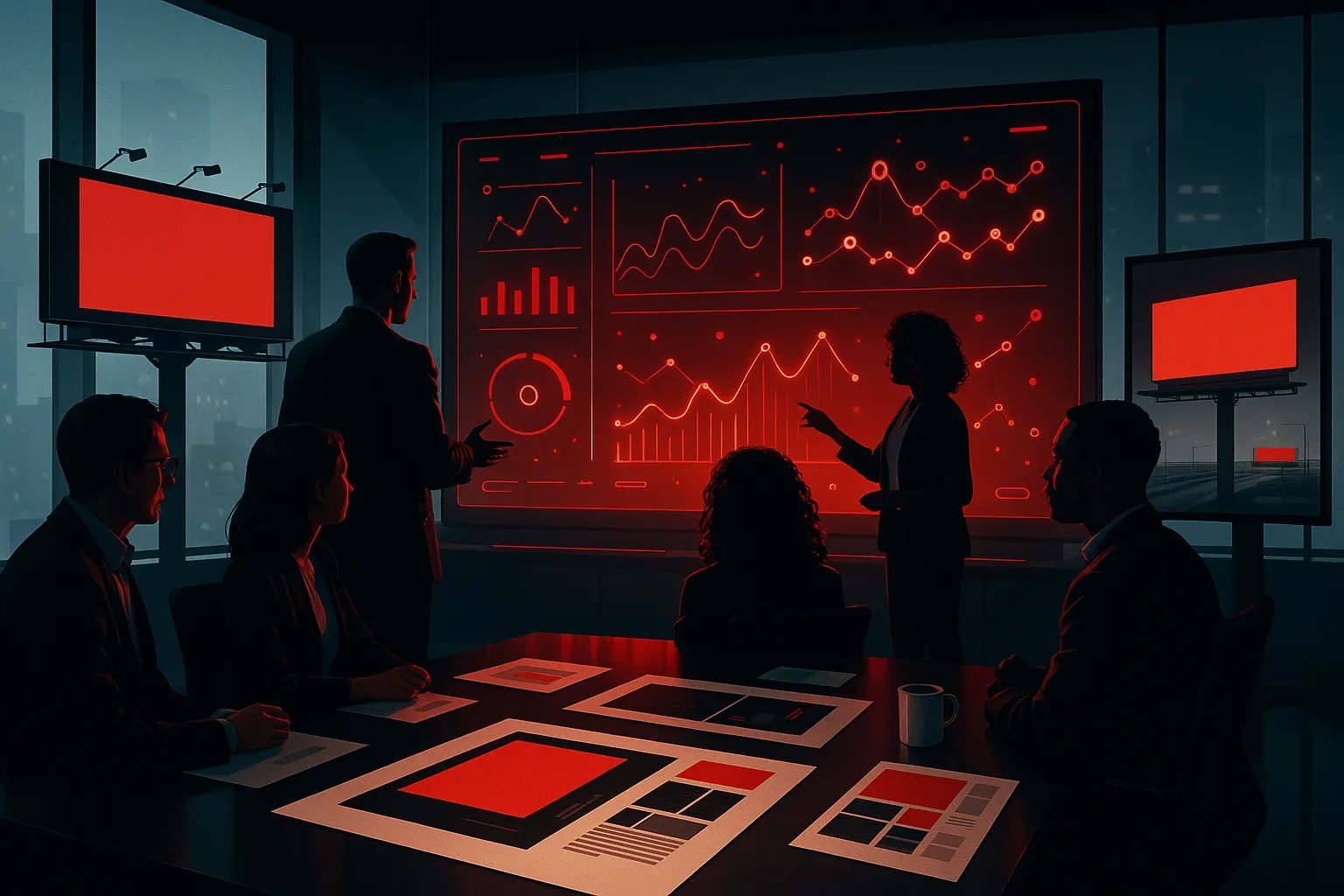
Performance improvements are based on structured analysis, not design preferences. Every recommendation is supported by measurable signals, field visibility standards, and controlled visual testing.
Data Sources We Analyze
When evaluating billboard design services, we review both creative and real world visibility factors. Our goal is to understand how quickly a message can be processed and how clearly it communicates authority.
We analyze:
Viewing distance simulations using visual testing systems
Speed based readability checks to measure message clarity in 3 to 6 seconds
Contrast ratios and color separation inside graphic design software
Layout hierarchy and focal point mapping in Adobe Photoshop
Motion and digital screen timing where applicable using Adobe Premiere
Brand consistency across other active marketing materials
These signals help us determine whether the billboard creative design delivers a clear message under real roadside conditions. A billboard must work at speed, from distance, and with limited attention. We test designs under those constraints before final delivery.
Example Findings We Often Identify
During review, we often identify patterns that reduce performance:
Headlines that require too many words to understand
Weak contrast between background and primary message
Visual clutter that competes with the main call to action
Logos placed in low visibility zones
Overuse of design elements that distract from the focal point
In many billboard graphic design reviews, we find that layout balance is technically correct but not optimized for high speed environments. These findings are documented with annotated mockups showing where attention is split or delayed. Resolving these issues improves message retention and recall.
Example Analysis Scenario
A common scenario involves a visually appealing design that tests well in a boardroom but fails readability simulations.
In this case, we compare:
Static mockup review in graphic design software
Distance scaled previews
Speed based visibility simulations
Contrast and hierarchy overlays
If the design looks strong up close but loses clarity at simulated driving distance, we know the issue is not aesthetics but scale and hierarchy. Adjustments may include increasing headline weight, simplifying messaging strategy, or restructuring layout optimization to reduce cognitive load.
We only recommend changes after confirming the root cause across multiple testing conditions.
Real Tool Workflow
Our workflow combines creative and analytical tools.
Adobe Photoshop is used to test hierarchy, spacing, and contrast precision. Creative strategy tools help refine messaging strategy so the headline communicates value in seconds. Visual testing systems simulate real viewing conditions to prevent assumptions based on close range viewing.
For digital placements, Adobe Premiere allows us to test frame timing and motion pacing. Each tool provides a different signal. When results align across tools, we can confidently validate findings and move forward with multiple design variations if needed.
How Improvements Are Prioritized
Not every adjustment has equal impact. We prioritize improvements based on:
Expected increase in message clarity
Influence on brand authority perception
Ease of implementation within the layout
Alignment with business goals
Technical feasibility within print specifications
Changes that significantly improve readability or brand recognition are addressed first. More subtle refinements follow once the core message is clear and visually dominant.
This structured evaluation process ensures that creative decisions are grounded in measurable performance standards rather than personal preference.
Who This Is For
This service is designed for businesses that want measurable improvement in brand visibility and customer acquisition through physical advertising. It is built for companies that see billboard space as a serious investment and want the creative to perform under real roadside conditions, not just look good in a presentation.
Good Fit
This service is a strong fit for:
Local businesses that depend on steady inbound calls, store visits, or service bookings.
Brands entering a competitive market and needing fast recognition from passing traffic.
Companies launching a new location, product, or rebrand that require clear, high-impact visibility.
Businesses investing significant budget into outdoor media and wanting accountability behind the creative decisions.
Established brands seeking stronger authority presence along major roads or highways.
If your billboard needs to communicate one clear message in a few seconds and leave a lasting impression, this approach is built for that environment.
Common Starting Situations
Many businesses come to us after experiencing issues such as:
A billboard that looks attractive up close but is hard to read from the road.
Too much information crammed into limited space.
Weak brand recall despite high traffic placement.
Internal disagreement about which version of the design is “best.”
Paid placement secured, but uncertainty about whether the creative will perform.
These situations often stem from designing for aesthetics rather than real driving conditions.
Not a Fit
This service may not be ideal for:
Businesses looking for a quick, low-cost design without testing or review.
Companies unwilling to simplify messaging for clarity.
Organizations unable to approve or implement revisions.
Advertisers expecting guaranteed immediate sales from one placement.
Outdoor advertising works best when treated as a strategic brand investment, not a short-term experiment.
Our Process
Strong outdoor results come from a structured process, not random tweaks. With billboard design services, we follow a clear workflow that keeps the message simple, the visuals readable, and the final files ready for production without delays.
Step 1: Initial Assessment
We start by reviewing what already exists and what the billboard needs to do in the real world. This includes your current brand materials (logo versions, colors, fonts, and style rules) and any past ads you’ve run.
Next, we look at the placement details: location type (highway, street-level, or urban), viewing distance, speed of traffic, and the direction of approach. If you already have board specs, we review dimensions and orientation to avoid scale problems later.
We also check the content inputs—your offer, required wording, phone numbers, and any legal lines—so we understand what must fit and what can be simplified.
Step 2: Strategic Planning
After the assessment, we translate constraints into a plan that guides the creative. We define the single main message the billboard should communicate in seconds. Then we set a clear priority order: headline first, key visual second, brand element third, and only then supporting details if space allows.
We outline how the viewer will read the board at speed, including where their eyes should land first and how quickly the message should resolve. We also plan the design approach based on your goal, such as brand recognition, directional awareness, or a focused promotion.
This step matters because it prevents crowded layouts and helps the final concept stay clear even when viewed briefly.
Step 3: Implementation
Design starts with quick layout drafts to test spacing, hierarchy, and balance before refining details. We build the creative to match the board’s exact proportions, then select type and imagery that stay legible at long distance.
As the design develops, we check contrast, simplify shapes, and reduce extra elements that compete with the main message. We also confirm that brand marks remain readable and that important information is placed where it won’t get lost near edges or busy areas.
Throughout production, we keep specs in mind—safe areas, bleed needs, and the limitations of large-format printing—so the final art translates cleanly from screen to physical billboard.
Step 4: Monitoring and Measurement
Once a direction is close to final, we evaluate it using practical checks. We review readability at scaled-down sizes to mimic quick viewing, and we test how the design holds up in different lighting conditions.
If you have performance inputs—like call volume spikes, offer redemptions, or location-based feedback—we use those signals to understand what’s working. The goal is not perfect data, but clear indicators that the message is being understood and remembered.
Step 5: Continuous Refinement
Based on what we learn, we make targeted updates: tightening the headline, increasing contrast, simplifying the visual, or adjusting the call-to-action format. Refinement is done in small, controlled changes so the design improves without introducing new confusion.
When the billboard is part of a longer campaign, we also carry learnings into the next round of creative, improving clarity and consistency over time.

Pricing
Pricing depends on the scope of work, technical complexity, and the specific needs of your business. Project cost varies with the creative brief, delivery formats, and whether the design needs to be adapted for multiple locations or sizes.
Projects typically start around 300 — suitable for a single, simple outdoor creative or a quick refresh for a local location.
Most businesses invest between $300-$1500/design — this range covers multi-size layouts, tighter brand alignment, and a few rounds of revisions for regional campaigns.
Larger or more complex implementations may range $2000-$10000+/campaign — larger budgets reflect multi-board systems, custom illustration or photography, coordinated production files, and campaign-level strategy for multiple markets.
Common factors that influence pricing include:
size of the website
number of pages or services involved
technical complexity
competitiveness of the market
level of ongoing support required
current condition of the website
These factors affect time and resources needed. For example, technical complexity can increase design and file-prep time. A competitive market may require more testing and variation. The current condition of your existing assets determines whether we start from a rough concept or build a complete brand set.
Most projects begin with a consultation or creative review to define scope, deliverables, and timelines. That initial review helps determine which items above apply so you only invest in the work that will deliver clear value.

Next Step
The next step is a consultation to learn about your business goals and current situation. This conversation helps us understand where you are and what you hope to achieve.
During the conversation we will clarify priorities, scope, timeline, and the level of work needed. This helps set expectations and focus effort on what matters most.
The purpose of the discussion is to identify practical opportunities and to see whether the service is a good fit. It is a straightforward way to assess alignment and possible value.
If you would like to explore the service further, you can schedule a consultation.