
Service
Automated Social Media Posts in Daytona Beach for Consistent Lead Generation

Automated social media posts help businesses stay visible and consistent without hiring a full in‑house content team. Many companies in Daytona Beach rely heavily on paid ads because their organic channels are inconsistent or inactive. Others publish randomly, then wonder why engagement drops and leads slow down. High‑volume AI content solves this by keeping your brand active across platforms, reinforcing offers, and driving steady traffic back to service pages and landing pages designed to convert.
In practice, this service uses structured content templates, campaign calendars, and AI workflows to generate weeks or months of posts in advance. Before optimization, most businesses struggle with scattered messaging, weak keyword alignment, and no clear internal linking between social content and high‑intent pages. We often see companies managing dozens of service pages but failing to support them with consistent top‑of‑funnel content that feeds traffic into those assets. Without a defined architecture and tracking system, volume alone does not translate into leads.
RockN' Socials approaches this with data‑driven ranking analysis and structured optimization roadmaps tailored for local service businesses and growing companies relying on inbound leads. Every campaign is backed by search visibility reports and performance dashboards that show how content supports traffic and conversions. On this page, you will see how we build, deploy, and measure scalable AI content systems that drive consistent lead generation.
What You Get
This service provides a structured system for producing large volumes of ready-to-publish content. You receive organized assets, captions, and scheduling support designed to support consistent publishing without manual daily work.
Deliverables
Bulk content batches
Pre-built content sets delivered monthly or quarterly, including post copy, visual direction, and platform formatting based on your approved content themes.Platform-ready assets
Cropped and formatted images and short-form videos sized for each social platform, created using Adobe Photoshop and Adobe Premiere when needed.Caption library
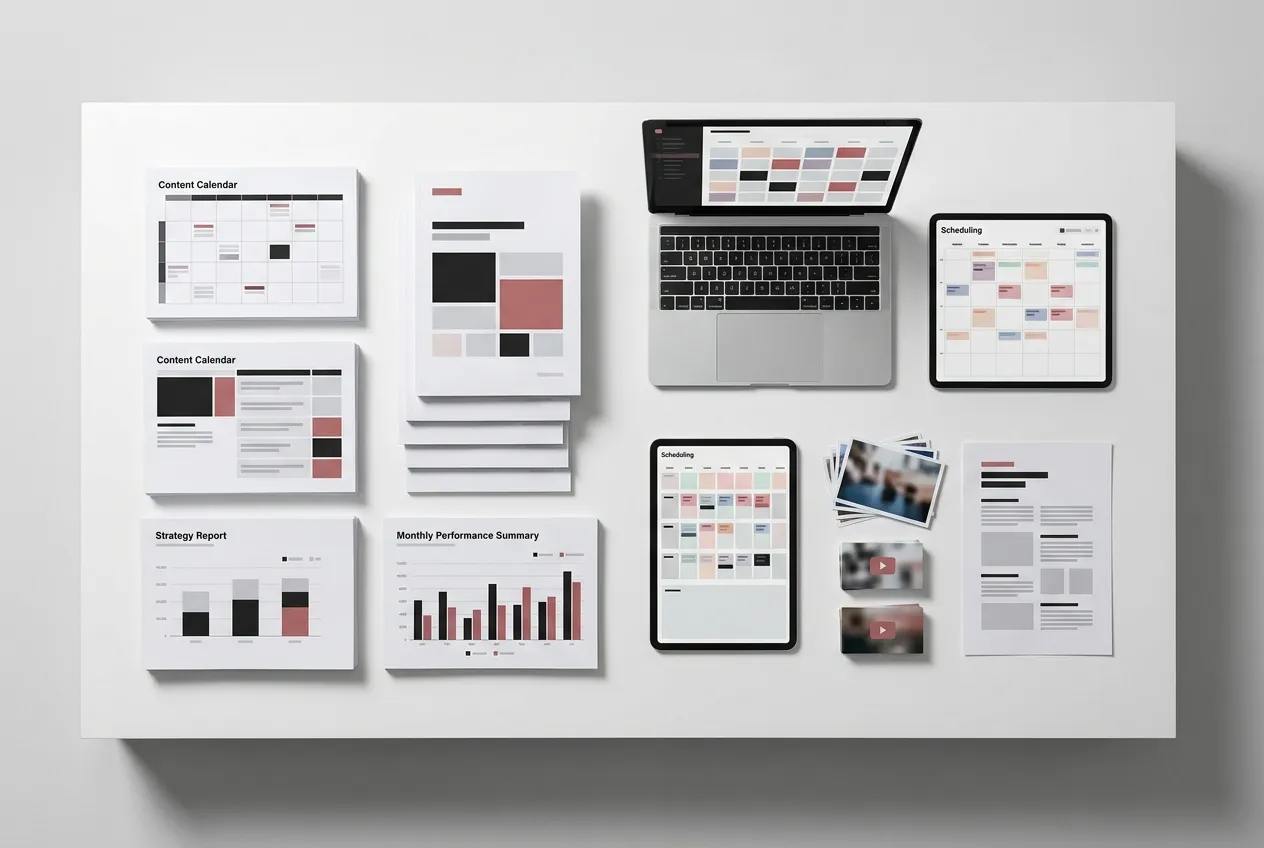
A structured document containing finalized captions, call-to-action variations, hashtag groupings, and tone adjustments aligned with your brand guidelines.Content calendar document
A dated posting schedule showing publish times, platforms, asset references, and campaign groupings to support organized rollout.Scheduling setup and upload support
Posts loaded into approved scheduling platforms with captions, links, and media attached for review prior to publication.Scalable content workflow system
A repeatable production process documented inside RockN' Socials CRM, including topic planning templates, approval checkpoints, and asset storage structure.Monthly performance summary
A report outlining publishing volume, engagement patterns, content type distribution, and production efficiency metrics.
This structure is built for businesses operating in Daytona Beach that need consistent output without expanding their internal team.
Tools and Access
We use RockN' Socials CRM to manage content planning, approvals, asset tracking, and workflow documentation.
AI content generation tools and content automation systems are used to produce structured drafts, caption variations, and bulk topic clusters. All drafts are reviewed and adjusted to align with your brand voice and audience expectations.
Scheduling platforms are used to queue and organize posts. Asset management tools store approved media, organized by campaign and month for easy retrieval.
To operate efficiently, we require:
Administrative or editor-level access to your social platforms
Brand guideline documents
Visual asset libraries or product imagery
Clear audience definitions and content direction
What You’ll Be Able to Review
You will have access to structured artifacts throughout the engagement, including:
A shared content calendar showing planned posts and publish dates
Caption documents prior to scheduling
Uploaded drafts inside your scheduling platform for approval
Asset folders organized by month and campaign
A monthly reporting document summarizing production output and engagement trends
This ensures you can review, approve, and adjust before content goes live. Companies serving customers in Daytona Beach can also review localized messaging before publication to ensure accuracy and tone alignment.
What We Need From You to Start
To begin production, we need:
Brand guidelines, tone preferences, and messaging rules
Platform access with publishing permissions
Target audience details including demographics and content goals
Existing content examples that represent your preferred style
Campaign priorities or promotional timelines
Once these materials are received, we build the first content batch, submit it for review, and activate the recurring production workflow.
How We Evaluate and Improve Performance
Improving performance with templated and bulk AI content starts with structured analysis, not assumptions. Every recommendation we make is based on measurable data pulled from the systems that power content production, distribution, and engagement.
Data Sources We Analyze
We review performance data from multiple connected systems to understand both output efficiency and audience response.
From RockN' Socials CRM, we analyze publishing consistency, asset usage, campaign tagging, and engagement tracking. This helps us see whether automated social media posts are aligned with campaign goals and whether posting frequency matches the intended strategy.
Using AI content generation tools and content automation systems, we evaluate:
Prompt structures and content variations
Caption engagement patterns
Repetition frequency across bulk batches
Platform-specific formatting accuracy
Scheduling platforms provide timing data, audience activity trends, and post-by-post engagement comparisons. Asset management tools show which visuals are reused, underutilized, or misaligned with current messaging.
For creative quality review, Adobe Photoshop and Adobe Premiere are used to audit visual clarity, branding consistency, and format compliance across platforms.
Each source provides a different signal. Combined, they reveal whether performance issues stem from content structure, creative assets, scheduling patterns, or system configuration.
Example Findings We Often Identify
During analysis, we frequently uncover patterns such as:
High output volume but declining engagement over time
Repetitive caption structures across bulk content creation
Strong visuals paired with weak calls to action
Platform-ready assets that are formatted correctly but lack contextual relevance
Inconsistent scheduling intervals that disrupt audience behavior patterns
We document these findings inside the CRM with batch identifiers, content themes, and publishing timelines. This allows us to trace performance back to specific templates, prompts, or scheduling rules.
Resolving these issues often improves content efficiency and audience response without increasing production volume. In most cases, the issue is not quantity but structure and refinement.
Example Analysis Scenario
For businesses operating in Daytona Beach, we sometimes see strong visibility during peak tourism periods but weaker engagement during off-season months.
In this scenario, we compare:
Scheduling platform engagement trends
CRM campaign tagging data
AI-generated caption themes
Asset usage frequency
If reach remains stable but engagement drops, we examine whether the content themes are seasonal or generic. We then review caption generation patterns to see if prompts are too broad for shifting local audience behavior.
By comparing multiple data sources, we determine whether the issue is content relevance, timing, creative fatigue, or automation configuration before recommending changes.
Real Tool Workflow
Our evaluation workflow connects systems rather than reviewing them in isolation.
RockN' Socials CRM centralizes publishing data and campaign structure. AI content generation tools provide insight into how prompts influence tone and engagement. Scheduling platforms reveal timing patterns and performance gaps. Asset management tools track visual reuse and brand consistency. Adobe Photoshop and Adobe Premiere allow us to audit and adjust creative elements when format or quality impacts results.
Each tool answers a different question. Reviewing them together prevents incorrect conclusions, such as blaming content volume when the real issue is timing or creative fatigue.
How Improvements Are Prioritized
We rank improvement opportunities based on impact and implementation effort.
Priority is typically given to:
Structural issues affecting entire content batches
Prompt adjustments that improve scalability
Scheduling changes that influence platform-wide engagement
Creative updates that affect brand consistency across assets
Lower-priority refinements, such as minor caption variations, are scheduled after high-impact adjustments are deployed.
This structured prioritization ensures that scalable improvements are implemented first, allowing content systems to perform more effectively as production volume increases.

Our Process
Strong results come from a repeatable workflow, not random posting or last-minute changes. Our process is designed to produce consistent, high-volume content while keeping your brand voice, approvals, and publishing schedule organized from start to finish.
Step 1: Initial Assessment
We start by reviewing your current digital presence to understand what already exists and what’s missing. This includes a look at your active social profiles, recent post history, and any ongoing campaigns or offers.
We also review your brand guidelines, voice, and visual style so new content doesn’t feel disconnected from what customers already recognize. If you have multiple audiences or locations you serve, we note those differences early so the content doesn’t speak too broadly or make incorrect assumptions. For businesses operating in Daytona Beach, we also consider local audience behavior, seasonality, and the types of messages that tend to get attention in a competitive service market.
Step 2: Strategic Planning
Next, we turn what we found into a clear content plan. This is where we define the content themes, posting mix, and the purpose of each theme (education, proof, offers, community, or reminders).
We map out:
Content categories and how often each one should appear
Tone rules (what to say, what to avoid, and what “on-brand” looks like)
Calls-to-action and how direct they should be based on your goals
Any constraints like compliance language, review policies, or sensitive topics
This step matters because high-volume production only works when the inputs are clear. Without a plan, automated social media posts can become repetitive, off-message, or focused on the wrong priorities.
Step 3: Implementation
Implementation is where production happens in a structured way. We generate content drafts in batches, then refine them so they match your voice and are easy to approve.
This phase typically includes:
Writing and editing captions with consistent formatting and tone
Building variations so posts don’t feel copy-pasted across a month
Creating or assigning visual direction so the content has a clear look
Checking that posts align with any promotions, events, or scheduling needs
We also apply basic quality checks before anything is prepared for scheduling, such as clarity, brand fit, and whether the post makes sense without extra context. The goal is to deliver content that is ready to publish, not content that still needs heavy internal rewriting.
Step 4: Monitoring and Measurement
After posts are scheduled or published, we track how the content performs so future batches are based on evidence, not guesses. We focus on practical indicators like which themes earn the most attention, what formats drive stronger engagement, and whether certain topics create drop-off.
We also watch for patterns over time, such as which days and times are consistently weak or strong for your audience. Companies serving customers in Daytona Beach may see noticeable swings during busy travel periods, so we factor those shifts into how we interpret results.
Step 5: Continuous Refinement
Each cycle improves the next. We use performance feedback and your internal notes to refine the plan, update themes, and adjust tone, formatting, or topic selection.
Continuous refinement may include:
Retiring topics that underperform or feel too repetitive
Expanding themes that consistently earn engagement
Tightening brand voice rules based on what gets approved fastest
Updating content to reflect new offers, services, or audience questions
This keeps the system efficient while ensuring the content stays accurate, relevant, and aligned with your business as it evolves.

Pricing
Pricing depends on the scope of work, technical complexity, and the needs of the business. For companies serving customers in Daytona Beach, local market conditions and content volume needs are common factors when we estimate cost.
Projects typically start around $100/piece — applies to single, simple assets such as a single social post or short template-based item for a local campaign.
Most businesses invest between $100-$300/piece — typical for ongoing campaigns that require multiple pieces per week, consistent voice across channels, or modest customization.
Larger or more complex implementations may range $3000-$15000+/month — applies to enterprise-level programs with high daily output, multi-channel scheduling, custom integrations, or dedicated account management.
Common factors that influence pricing include the size of the website or content program, the number of pages or services involved, and the technical complexity of publishing and integrations. Market competitiveness also affects cost, since more competitive markets often require higher volume or more variations. The level of ongoing support required — editing, approval workflows, analytics, and revisions — changes price. Finally, the current condition of a business’s content systems and templates can raise or lower the effort needed to reach goals.
Most projects begin with a consultation or a content review to define scope, priorities, and measurable goals. That initial assessment helps determine exactly which deliverables are needed so businesses only invest in the work that will provide clear value.
Next Step
The next step is a consultation to understand your business goals and current situation. We focus on learning how businesses operating in Daytona Beach approach marketing needs and what you want to achieve.
The conversation helps clarify priorities, scope, timeline, and the level of work needed. It creates a clear view of what to focus on.
The purpose of the conversation is to identify practical opportunities and determine whether the service is a good fit. It also helps both sides see if the approach matches your goals and available resources.
If you would like to explore the service further, you can schedule a consultation.
FAQ'S
Frequently Asked Questions
Quick answers about how we help businesses grow.