
Service
Online Reputation Management Service in Daytona Beach for Increased Local Visibility

Online reputation management service is essential for businesses that depend on search visibility and customer trust to drive calls, bookings, and walk‑ins. When potential customers compare companies in Daytona Beach, star ratings, recent reviews, and response activity often determine who earns the lead. I have seen businesses with solid websites lose inquiries simply because negative reviews were unanswered or fresh reviews stopped coming in. Even companies investing heavily in paid ads struggle to convert traffic when their public feedback tells a different story.
Most reputation problems are not random. They stem from inconsistent review generation, poor response workflows, and a lack of monitoring tied to search performance data. Reputation protection online requires structured systems that request feedback at the right time and flag risk before it impacts rankings. A white label reputation management service becomes critical for companies managing dozens of service pages or expanding into new areas, where review signals influence local pack visibility. Without automation and tracking, review velocity slows, sentiment declines, and search impressions follow.
At RockN' Socials, we approach reputation management with structured optimization roadmaps backed by search visibility reports and review sentiment tracking dashboards. We work closely with local service businesses and professional service firms to implement review generation systems, automate compliant responses, and mitigate negative feedback before it spreads. Below, you will see how our process protects credibility while strengthening local search performance across Daytona Beach.
What You Get
You receive a structured system for monitoring, improving, and protecting your brand reputation across major review platforms. This service turns reviews into a managed business asset instead of a reactive task.
Deliverables
Reputation Audit Report
A baseline assessment of your current ratings, review volume, response rate, and sentiment trends across platforms such as Google and Yelp.Review Generation System Setup
Configured review request workflows connected to your customer interaction points, including email and SMS triggers. Includes message templates aligned with your brand voice.Automated Review Request Workflows
Active workflows that send review requests at defined stages of the customer journey, with tracking of delivery and response rates.Response Management for Incoming Reviews
Ongoing monitoring and written responses to new reviews, aligned with your brand guidelines and platform best practices.Negative Review Mitigation Plan
A documented escalation and resolution framework for handling low ratings, disputes, and reputation risks. Includes response templates and internal handling steps.Multi-Platform Monitoring and Aggregation
Centralized tracking of reviews across major platforms using aggregation tools for full visibility.Monthly Reputation Performance Report
A structured report detailing review volume, rating changes, response activity, sentiment trends, and actionable recommendations.White Label Reputation Management Service Option
Available for agencies or partners that require branded reporting and client-facing deliverables under their own company name.
This structure supports both daily oversight and long-term reputation protection online, especially for businesses operating in Daytona Beach where reviews directly influence local buying decisions.
Tools and Access
This service is powered by the RockN’ Reputation Engine, supported by:
Review Generation & Request Systems
Automated Response & Monitoring Tools
Sentiment Tracking Systems
Multi-Platform Review Aggregation Tools
Reputation Analytics Dashboards
You will need to provide administrative or manager-level access to relevant review platforms such as Google, Yelp, and other industry-specific directories. Access to customer communication systems may also be required to implement automated review workflows.
Brand voice guidelines and any internal customer service policies are used to ensure responses remain consistent with your company standards.
What You’ll Be Able to Review
You will have visibility into:
A live dashboard showing total reviews, average rating, and rating trends
Response activity logs for transparency on published replies
Sentiment summaries that categorize positive, neutral, and negative feedback
Monthly performance reports outlining changes and improvement areas
Documentation of any mitigation actions taken for negative reviews
This gives you a clear view of how your reputation is evolving and how online reputation protection efforts are performing over time.
What We Need From You to Start
To begin, we require:
Access to all active review platforms
A list of customer touchpoints where review requests can be triggered
Brand voice guidelines or example responses
Internal escalation contacts for handling disputes or sensitive feedback
Once access and documentation are provided, system setup and monitoring can begin for companies serving customers in Daytona Beach and competitive industries where reviews influence conversion decisions.
How We Evaluate and Improve Performance
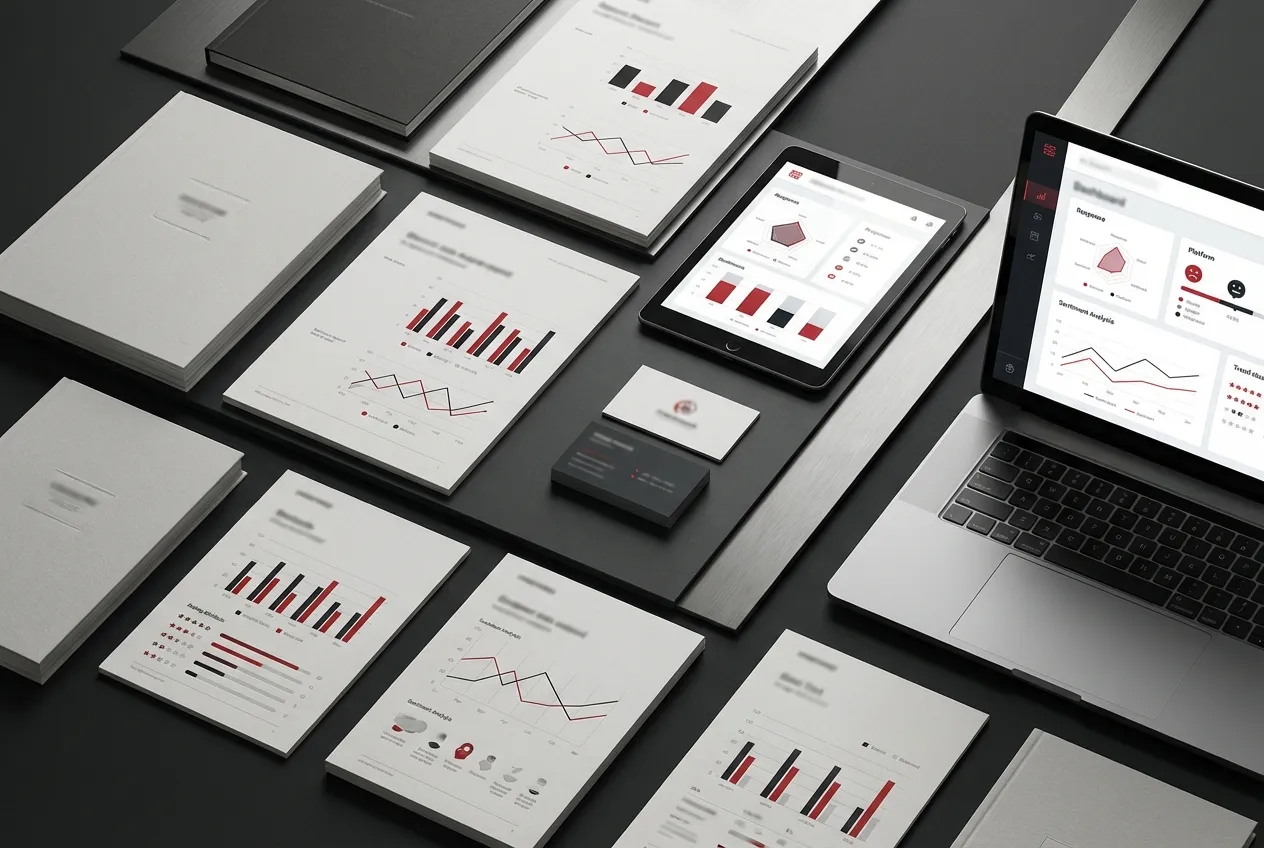
Improving reputation performance requires structured analysis, not assumptions. Our online reputation management service relies on measurable data from multiple platforms to identify patterns, diagnose issues, and prioritize corrective action.
Data Sources We Analyze
We collect and centralize data using the RockN’ Reputation Engine and Multi-Platform Review Aggregation Tools. This allows us to evaluate review activity across Google, Yelp, Facebook, and other industry specific platforms in one view.
Key signals we analyze include:
Total review volume and monthly growth rate
Average rating trends over time
Review frequency consistency
Response rate and response time
Sentiment patterns within written feedback
Platform specific visibility and engagement
Sentiment Tracking Systems help us identify recurring themes in both positive and negative feedback. Automated Response and Monitoring Tools provide insight into how quickly reviews are acknowledged and whether responses are improving perception.
Reputation Analytics Dashboards help us compare historical performance against current trends to determine whether changes are improving overall brand perception or creating new issues.
Example Findings We Often Identify
During audits, we commonly uncover patterns such as:
Strong ratings but declining review frequency
High review volume on one platform but neglect on others
Slow or inconsistent responses to negative feedback
Repeated complaints about a specific service issue
Sudden rating drops tied to operational disruptions
These findings are documented within our dashboards and categorized by severity and impact. For example, a pattern of delayed responses can weaken reputation protection online because unresolved complaints remain visible without context. Identifying and correcting these issues improves both trust signals and conversion likelihood.
Example Analysis Scenario
For businesses operating in Daytona Beach, seasonal traffic patterns often affect review behavior. A company may see high customer volume during peak months but inconsistent review generation afterward.
In one common scenario, review volume increases but average rating declines. We compare:
Sentiment data from recent reviews
Response activity logs
Timing of operational changes
Platform specific rating shifts
If sentiment tracking shows recurring service complaints during peak periods and response time slowed at the same time, the issue is likely operational strain rather than platform bias. We confirm this by reviewing monitoring data and response workflows before recommending process adjustments or automation updates.
This layered comparison prevents misdiagnosing short term fluctuations as long term reputation damage.
Real Tool Workflow
Our evaluation process integrates multiple systems to avoid incomplete conclusions.
The RockN’ Reputation Engine aggregates incoming reviews. Review Generation and Request Systems track outbound requests and completion rates. Automated Response and Monitoring Tools measure response consistency. Sentiment Tracking Systems classify tone and recurring themes.
By combining these signals, we can determine whether a decline in rating is caused by:
Reduced review requests
Negative experience clusters
Platform visibility changes
Lack of timely engagement
Each tool provides a different data point. Together, they create a complete performance picture.
How Improvements Are Prioritized
We rank improvements based on impact, urgency, and visibility risk.
Issues that directly affect public perception, such as unresolved negative reviews or declining response rates, are addressed first. Next, we optimize review generation workflows to ensure steady growth. Finally, we refine monitoring and automation settings to maintain long term online reputation protection.
This structured prioritization ensures the most influential reputation factors are stabilized before expanding into broader white label reputation management service enhancements or platform expansion strategies.

Our Process
Strong reputation results come from a structured process, not random replies or last-minute fixes. This workflow turns reviews into a managed system with clear ownership, consistent timing, and measurable improvements—so your online reputation management service runs like an operation, not a scramble.
Step 1: Initial Assessment
We start by gathering a clear picture of your current reputation footprint. This includes reviewing your profiles across major review platforms, checking that listings are accurate, and identifying where customers are most active.
We look at practical signals such as review patterns over time, the mix of positive vs. negative feedback, common themes in comments, and how quickly reviews are being addressed. We also review your current customer communication flow (where feedback is requested, if at all) to see what’s realistic to automate without disrupting your customer experience. For businesses operating in Daytona Beach, we also account for local customer behavior, where fast decisions are often influenced by recent reviews.
Step 2: Strategic Planning
Next, we translate what we found into a plan that your team can actually follow. The goal is to set priorities that protect trust first, then improve volume and consistency over time.
We define:
Which platforms matter most based on your customer journey
The best moments to ask for a review (after purchase, after service completion, after support resolution, etc.)
Response guidelines based on your brand voice, including what to say and what to avoid
Escalation rules for sensitive issues so problems get handled internally before they grow
This plan becomes the operating playbook for online reputation protection, so staff are not guessing when a tough review comes in.
Step 3: Implementation
With the plan approved, we build and configure the systems. This is where the process becomes repeatable.
We set up review request workflows tied to real customer touchpoints and ensure messaging fits your tone. We also configure monitoring so new reviews are captured quickly and routed to the right place.
Response operations are implemented with clear rules: which reviews receive a public reply, what response types are used, and when an issue should be escalated to a manager. We also apply safeguards to reduce risk, like avoiding sensitive details in public replies and keeping responses consistent across platforms.
Step 4: Monitoring and Measurement
Once the system is live, we track performance signals that tell us whether the process is working. That includes review volume trends, rating movement, response timing, and sentiment shifts.
We also monitor for anomalies—like sudden rating drops, repeated complaints, or platform issues—so you can address root causes quickly. For companies serving customers in Daytona Beach, this matters because even short bursts of negative feedback can influence near-term inquiries during busy periods.
Step 5: Continuous Refinement
Reputation management is never “set and forget.” We use ongoing results to refine what’s working and fix what isn’t.
Over time, we adjust:
Request timing and messaging to improve completion rates
Response templates to better match customer language and expectations
Escalation steps to speed up resolution and reduce repeat issues
Operational gaps revealed by negative review patterns
This keeps your reputation system stable, realistic for your team, and resilient as customer expectations change.

Pricing
Pricing varies based on the scope of work, technical complexity, and the needs of the business. For companies serving customers in Daytona Beach, local competition, review volume, and customer touch points can change the level of effort required.
Projects typically start around $100/Month — suitable for single-location small businesses or basic review collection and response templates.
Most businesses invest between $100-$3,000/Month — common for multi-location companies, active review outreach, response automation, and regular monitoring and reporting.
Larger or more complex implementations may range $3,000+/Month — applies to enterprise setups with advanced automation, integrations, dedicated staff, and high-volume review management.
Common factors that influence pricing include:
size of the website — larger sites or multiple domains require more setup and ongoing monitoring.
number of pages or services involved — more services or listings increase the configuration and review coverage needed.
technical complexity — integrations with CRMs, booking systems, or custom platforms add development time.
competitiveness of the market — crowded local markets often need more proactive outreach and faster response workflows.
level of ongoing support required — hourly support, rapid response SLAs, or dedicated account management raise recurring costs.
current condition of the website — poor listings, incomplete profiles, or inconsistent information require remediation before systems can perform well.
Most engagements begin with a consultation or a review of current listings and processes to define the correct scope. That initial assessment helps set realistic expectations so businesses invest only in the improvements that deliver practical value.
Next Step
The next step is a consultation to understand your business goals and current situation. This meeting is focused on listening to how your business is operating and where you want to go.
The conversation helps clarify priorities, scope, timeline, and the level of work needed. It also lets us establish which areas should be addressed first so effort is focused.
For businesses operating in Daytona Beach, the discussion can reveal practical opportunities tied to local customer expectations. The goal is to determine whether this service is a good fit for your needs.
If you would like to explore the service further, you can schedule a consultation.
FAQ'S
Frequently Asked Questions
Quick answers about how we help businesses grow.