
Service
Email Marketing As A Service in Daytona Beach for Consistent Lead Generation

Email marketing as a service helps businesses turn website traffic and past customer data into predictable lead flow and repeat sales. Many companies in Daytona Beach rely heavily on paid ads or social media for attention, yet their inbox strategy is either inconsistent or completely manual. That usually means leads go cold, past buyers never hear from the brand again, and revenue opportunities are left on the table. When email systems are structured correctly, they support consistent inquiries, improve customer lifetime value, and reduce dependence on constant ad spend.
In practice, performance issues often start upstream with weak site architecture, slow page speed on opt‑in forms, or indexing problems that limit organic traffic growth. Without clean segmentation and tracking, automated email campaigns fail to trigger at the right time or align with user intent. Many growing companies managing dozens of service pages struggle to connect those pages to relevant lead nurturing emails that guide prospects toward a decision. Gaps in keyword targeting and internal linking also limit how many qualified subscribers enter the funnel in the first place.
RockN' Socials approaches this with structured optimization roadmaps built from search visibility diagnostics and real user behavior data. We review CRM integrations, form tracking, and engagement patterns, then validate improvements through SEO performance dashboards and conversion reporting. Our team supports local service businesses and small to mid-size companies that depend on steady inbound leads. On this page, you will see how we build, automate, and refine email systems for measurable growth.
What You Get
You receive a fully built and managed email system designed to turn existing contacts into repeat customers. This service gives businesses operating in Daytona Beach a structured way to increase retention and revenue using strategic messaging, automation, and performance tracking.
Deliverables
Complete email system setup inside your CRM or email platform, including account configuration, domain authentication, sender settings, and compliance setup.
Automated email campaigns built through structured workflows such as welcome sequences, abandoned cart reminders, re‑engagement flows, and post‑purchase follow‑ups.
Lead nurturing emails mapped to different stages of the customer journey, with messaging tailored to new leads, active buyers, and past customers.
Promotional campaign builds including offer emails, event announcements, seasonal campaigns, and product launches with subject lines, preview text, body copy, and call‑to‑action structure.
List segmentation framework based on behavior, purchase history, engagement level, and lifecycle stage using behavior tracking tools.
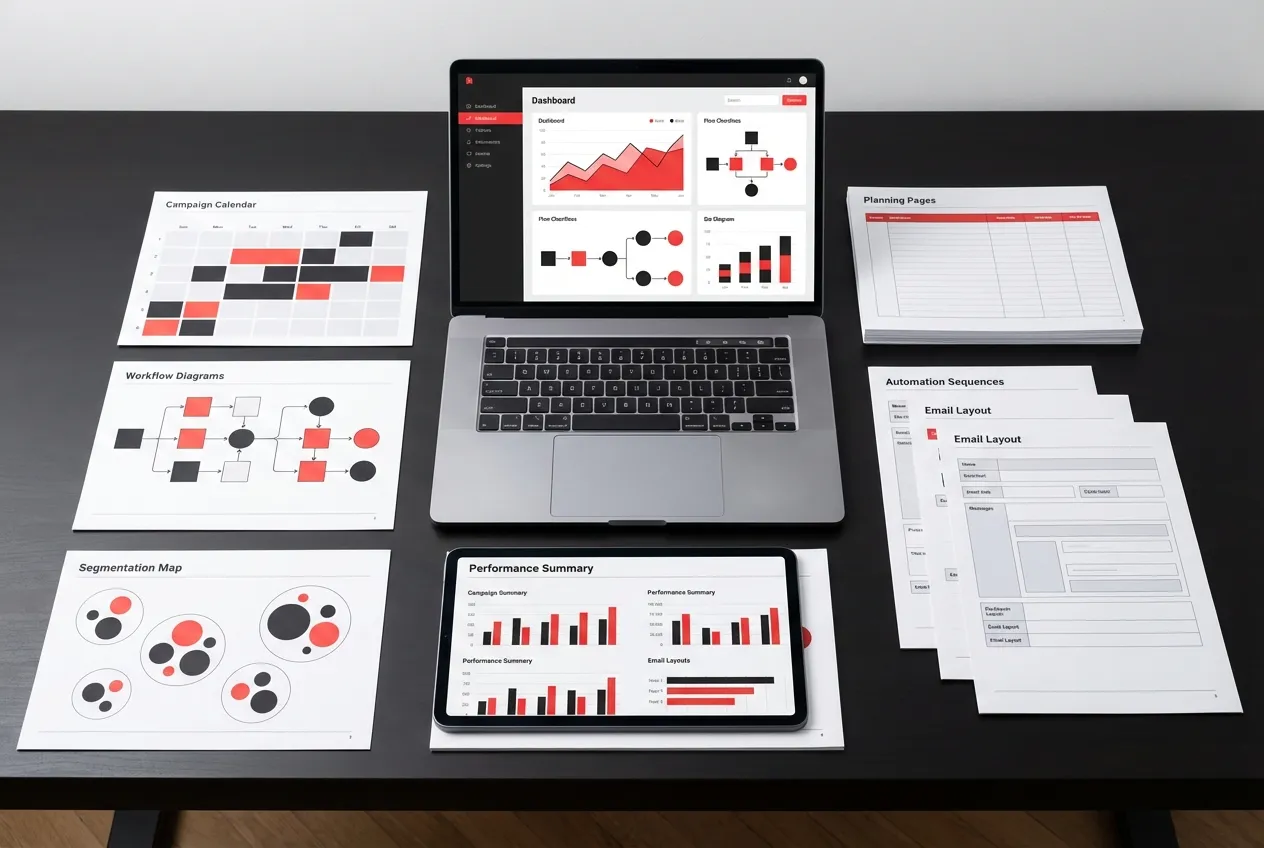
Campaign calendar document outlining monthly sends, automation triggers, and promotional timing.
Copywriting and creative assets generated using AI Copy & Campaign Generation Systems, reviewed and aligned with your brand messaging guidelines.
Performance optimization log documenting subject line tests, content adjustments, send time experiments, and segmentation refinements.
Monthly performance report summarizing open rates, click‑through rates, conversions, unsubscribe rates, and revenue contribution from email activity.
Tools and Access
We build and manage your campaigns using the RockN’ Email Automation Engine and RockN' Socials CRM & Email Marketing Platforms. These systems support workflow automation, tagging, segmentation, and revenue attribution.
Automation Workflow Builders are used to create trigger‑based sequences. List Segmentation & Behavior Tracking Tools monitor actions such as clicks, purchases, and inactivity. Performance & Revenue Tracking Systems connect email engagement to actual sales activity.
You will need to provide:
Access to your email platform or CRM
Access to your existing customer or lead database
Details about your offers, services, or products
Brand voice and messaging guidelines
If you are currently using a mailchimp email marketing service, we can audit, restructure, or migrate your account as part of the setup process.
What You’ll Be Able to Review
You will have visibility into:
Live automation workflows and campaign drafts before they are sent
Segmentation logic and audience filters
Monthly reporting dashboards with engagement and revenue metrics
Campaign calendar and send schedule
Optimization notes showing what changes were made and why
This structure allows companies serving customers in Daytona Beach to clearly see how email contributes to retention and repeat purchases.
What We Need From You to Start
To begin, we need platform access, your current contact list, and a summary of your offers and customer journey.
We also request past campaign data if available, examples of previous emails, and clarification on compliance preferences such as unsubscribe handling and data storage. Once access is confirmed, we map your customer lifecycle, define automation triggers, and begin building your email infrastructure.
How We Evaluate and Improve Performance
Improving results with email marketing as a service starts with structured analysis, not guesswork. Every recommendation we make is based on measurable data pulled from your campaigns, customer behavior, and revenue tracking systems.
Data Sources We Analyze
We review performance data from multiple systems to understand both engagement and revenue impact.
Using RockN’ Socials CRM & Email Marketing Platforms and our RockN’ Email Automation Engine, we evaluate:
Open rates by segment and device type
Click-through rates by link and content block
Conversion behavior tied to specific campaigns
Revenue generated from automated email campaigns
List growth, churn, and inactivity trends
Our List Segmentation & Behavior Tracking Tools show how subscribers move through funnels, which emails they ignore, and where drop-offs occur. Performance & Revenue Tracking Systems connect campaign activity to real purchases, not just clicks.
We do not look at metrics in isolation. A high open rate with low conversions signals a different issue than low opens with strong clicks. The context behind the numbers determines the next step.
Example Findings We Often Identify
During audits, we commonly document patterns such as:
Overlapping audience segments causing message fatigue
Lead nurturing emails that stop too early in the buying cycle
Promotional campaigns sent without behavioral triggers
Automation gaps between first purchase and repeat purchase
Lists growing but engagement steadily declining
Each finding is logged with supporting data screenshots and engagement trends. Fixing these issues often increases consistency, improves subscriber trust, and strengthens lifetime value without increasing ad spend.
Example Analysis Scenario
For businesses operating in Daytona Beach, we often see strong seasonal buying behavior. In one evaluation, a company had solid open rates but inconsistent revenue from email. When we compared CRM purchase timelines with campaign data, we found that messages were not aligned with local buying spikes tied to tourism cycles.
By analyzing engagement data alongside revenue contribution reports, we identified that subscribers were clicking but not receiving follow-up offers at the right time. The issue was not subject lines or design. It was timing and automation structure.
This type of cross-platform comparison prevents incorrect conclusions and ensures changes are based on real behavior patterns.
Real Tool Workflow
Our AI Copy & Campaign Generation Systems help test variations in messaging, but we validate performance through behavior tracking and revenue data before making structural changes.
Automation Workflow Builders allow us to map the full customer journey visually. We use this to identify:
Entry points into sequences
Trigger conditions for automated email campaigns
Delays between actions and follow-ups
Exit conditions that may remove contacts too early
The RockN’ Email Automation Engine records how contacts move between workflows. Meanwhile, CRM and revenue tracking systems confirm whether those movements result in purchases. This layered approach prevents us from optimizing for clicks alone.
How Improvements Are Prioritized
We rank improvement opportunities using three factors:
Revenue impact potential
Implementation complexity
Data confidence level
High-impact automation fixes that require minimal structural change are addressed first. Larger strategic changes, such as restructuring lifecycle messaging or expanding lead nurturing emails, are scheduled after foundational improvements are validated.
This prioritization ensures that businesses see measurable gains quickly while building a stronger long-term email system.

Our Process
Strong email results come from a structured system, not random sends and quick changes. Our workflow is designed to build a reliable program that improves over time, so you know what’s working, what’s not, and what to do next with email marketing as a service.
Step 1: Initial Assessment
We start by reviewing your current digital setup to understand the starting point and find hidden issues that can limit performance. This includes:
Reviewing your website and key conversion paths (forms, checkout, booking, lead capture)
Checking where contacts come from and how they are stored (lists, tags, fields, duplicates)
Auditing prior email sends and basic engagement patterns when available
Confirming sender setup basics that affect deliverability, like authentication status and list hygiene
Mapping what data you can track today (purchases, inquiries, page activity) and what’s missing
For companies serving customers in Daytona Beach, we also consider buying behavior that is often tied to timing, events, and seasonality, since these factors can change what messages make sense and when.
Step 2: Strategic Planning
Next, we turn the assessment into a clear plan with priorities. The goal is to decide what to build first, what to test later, and how each message supports a business outcome.
Planning typically includes:
Defining core audiences (new leads, active customers, past customers, and inactive contacts)
Setting goals for each audience (first purchase, repeat purchase, re-activation, referral)
Choosing the highest-impact sequences and campaigns to start with
Creating a simple messaging framework so emails stay consistent in tone and offers
Establishing tracking rules so results can be tied back to actions people take
This step matters because email works best when every send has a purpose and a defined audience.
Step 3: Implementation
With the plan approved, we build the system in your platform and connect the pieces so it runs reliably. This includes creating forms or integrations when needed, organizing contact data, and building templates that are easy to maintain.
We then build automated email campaigns with clear triggers and logic, such as what happens after someone signs up, buys, clicks, or goes inactive. Each workflow is set up with timing rules, message order, and exit conditions so people don’t get the wrong emails at the wrong time.
Before anything goes live, we run a full quality check: links, tracking, mobile formatting, personalization fields, and suppression rules.
Step 4: Monitoring and Measurement
After launch, we monitor performance to confirm the system is behaving correctly and to spot early wins or issues. We track engagement trends, deliverability signals, and downstream actions like inquiries or purchases.
We also review:
Which segments respond best to specific offers
Where people drop off in sequences
Which subject lines and layouts consistently earn clicks
Whether timing and frequency match audience behavior
Step 5: Continuous Refinement
Email programs improve through steady iteration. We use ongoing results to adjust targeting, timing, content structure, and workflow logic. Over time, this reduces wasted sends and increases the number of messages that feel relevant.
For businesses operating in Daytona Beach, we may also adapt around real-world calendar shifts that impact demand. Refinement stays focused on practical changes you can measure, not guesswork.

Pricing
Project cost varies based on the scope of work, technical complexity, and the specific needs of your business. Companies serving customers in Daytona Beach can face different competitive pressures and audience sizes, so final pricing is tailored after we review goals and current systems.
Projects typically start around $2,000 Setup ($300/Month) — suitable for small businesses or simple automated welcome and follow-up sequences that replace manual outreach.
Most businesses invest between $2,000-$12,000 Setup ($300-$5,000/Month) — this range covers multi-sequence campaigns, list segmentation, basic integrations with CRM or ecommerce platforms, and ongoing month-to-month content and analytics support.
Larger or more complex implementations may range $12,000+ Setup ($5,000+/Month) — applies to enterprise-level work with advanced automation, complex data integrations, custom reporting, and high-frequency campaign management.
Common factors that influence where a project falls in the ranges above include:
size of the website or online store
number of pages, products, or distinct services involved
technical complexity of integrations (CRMs, payment systems, custom APIs)
competitiveness of the market and required campaign sophistication
level of ongoing support and campaign management needed
current condition of existing systems and list hygiene
Most projects begin with a consultation or systems review to define scope and priorities. That initial assessment helps determine which investments will deliver the most value so businesses only pay for the improvements they actually need.

Next Step
The next step is a consultation to understand your business goals and current situation. It’s tailored to businesses operating in Daytona Beach so we can consider local factors as we learn about your needs.
The conversation will clarify priorities, scope, timeline, and the level of work involved. This helps set clear expectations and focus on what matters most.
The purpose of the discussion is to identify practical opportunities you can act on and to determine whether the service is a good fit. It aims to give a clear view of how the work could address your goals.
If you would like to explore the service further, you can schedule a consultation.
FAQ'S
Frequently Asked Questions
Quick answers about how we help businesses grow.